Across seven production multi-agent frameworks, UC Berkeley measured task failure rates between 41% and 86.7% — and reliability has barely improved even as the models underneath them get more capable. Here's why.

Three recent studies, from Princeton, UC Berkeley, and Queen's University, independently confirm that AI agent reliability has not kept pace with AI agent capability. Model accuracy keeps climbing. The consistency, robustness, and predictability of agents in production have barely moved. The result is a widening gap between what agents can do in an evaluation and what they can be trusted to do, unsupervised, with real systems and customers.
41% to 87% task failure in real-world multi-agent systems,
depending on the framework. UC Berkeley found failure rates from 41% to 86.7% across seven production multi-agent frameworks, and traced the largest share of it to fixable system design, not model limitations.
97.1% of AI agent tools have a description flaw. A Queen's University audit found that nearly every real-world MCP tool it examined had at least one significant documentation "smell," leaving agents to guess at how a tool actually works.
Four causes explain most of what goes wrong when an agent moves from demo to production:
• Reliability lags capability. Newer models are more accurate, not more consistent, robust, or self-aware about when they're likely to fail.
• System design, not model choice, drives the largest share of multi-agent failures. 44.2% trace back to issues like step repetition and unclear termination, both fixable without touching the model.
• Tools are poorly specified. Missing usage guidance and unstated limitations force agents to guess how and when to use a tool.
• Agents fail silently. With no exception or error code, an agent can confidently report success on a task it got wrong.
Ask any team that has shipped an agent into production and you'll hear a version of the same story. It worked in the demo. Then, a few weeks in, it did something strange. It called the wrong tool. It got stuck repeating a step. It told a customer their billing address had been updated when it hadn't. Nothing crashed. There was no stack trace, no error code. The agent just quietly did the wrong thing, confidently.
Three studies finally measured that gap directly. The short answer: agent capability and agent reliability are not the same property. Most of the industry has spent the last two years optimizing almost exclusively for the first one.
The most direct evidence comes from Towards a Science of AI Agent Reliability (Rabanser, Kapoor, Kirgis, Liu, Utpala, and Narayanan, Princeton University, ICML 2026), which evaluated 15 models across two agent benchmarks, GAIA and τ-bench, and measured reliability as something distinct from task accuracy for the first time.
The paper defines reliability across four dimensions. Consistency: does the agent produce the same result on repeat runs? Robustness: does it degrade gracefully when things change? Predictability: does it know when it's likely to fail? Safety: how bad is the outcome when it does fail? Its headline finding is that capability and reliability have decoupled.
“24 months of rapid capability gains have produced only small improvements in reliability: models that are substantially more accurate remain inconsistent across runs, brittle to prompt rephrasings, and often fail to understand when they are likely to succeed.” — Rabanser et al., 2026
Outcome consistency, how often an agent reaches the same result on the same task run twice, ranged from 0.58 to 0.84 on GAIA and 0.52 to 0.90 on τ-bench across the 15 models. The least consistent models produce a different result on nearly half of repeated runs, and even the steadiest diverge on about one run in ten. Agents also tend to pick similar actions across runs but vary the order they execute them in; they often know what to do without reliably knowing when. Confidence calibration is generally poor and hasn't meaningfully improved with newer models. Financial-accuracy errors are the single most common failure on τ-bench: agents getting a transaction wrong while sounding certain they got it right.
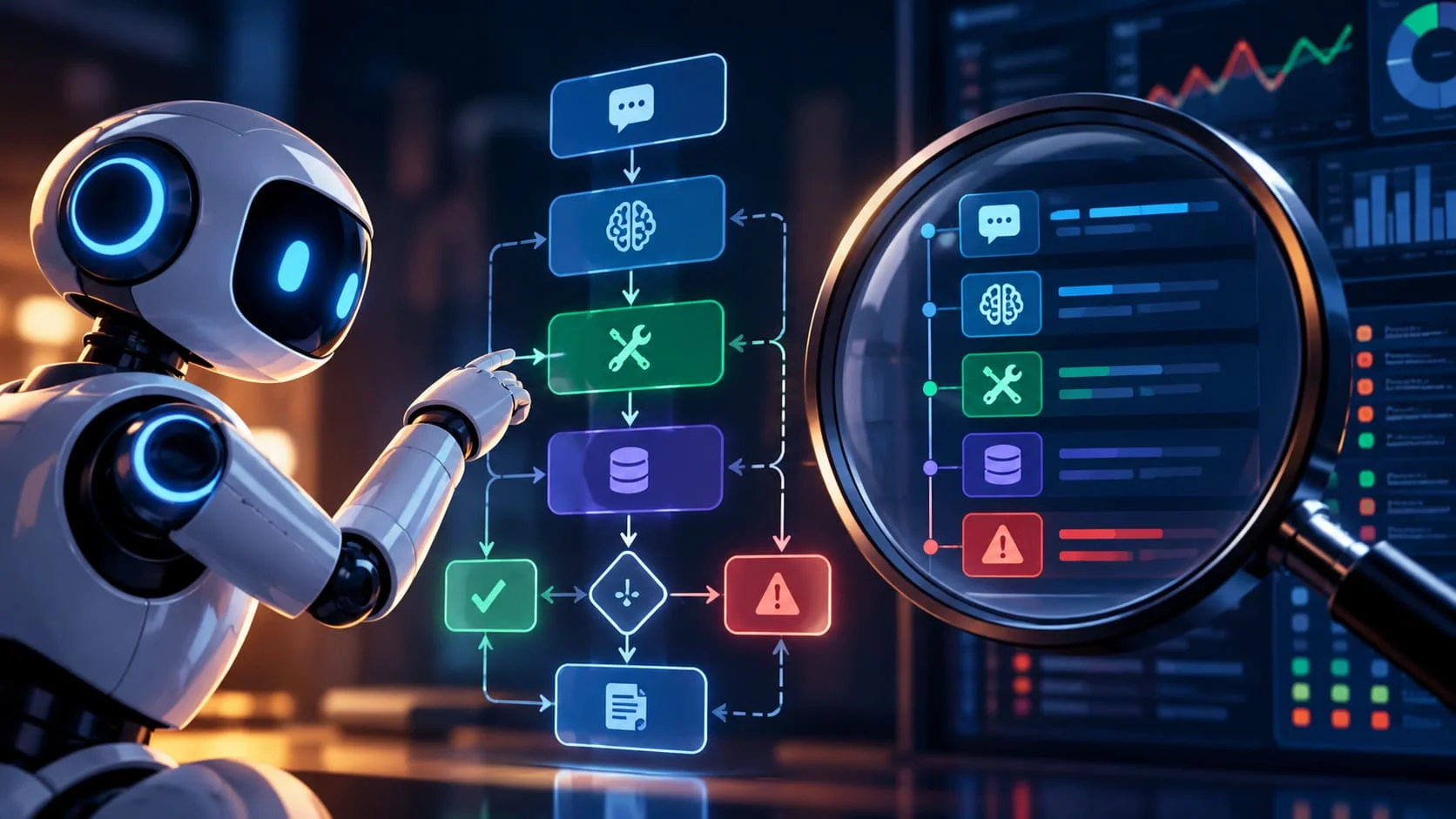
Traditional software follows a short, predictable path: input, code, output. Failure usually means an exception or a crash. An agent's path is longer. It reasons, selects a tool, constructs parameters, executes, observes, reasons again, and repeats. Every step is a place things can quietly go sideways. Ask an agent to find a customer's account and update their billing address, and it can search for the wrong customer, get three matches back and not ask which one, call the update tool with a bad parameter, misread a timeout as success, and tell the user the address was changed. Nothing throws an exception. The agent simply does the wrong thing successfully, which is why counting error rates from application logs radically understates how often production agents are actually failing.
An agent that succeeds 95% of the time on any single step completes a ten-step task 59.9% of the time, because the probabilities multiply. Retries and near-deterministic steps push real rates above the naive figure: a well-formed API call is not 95% reliable, it is 99.9%. Correlated failures push them below it, because one wrong turn poisons the context for every step after it, which is what step repetition and premature termination in the multi-agent failure traces actually are. The geometric model is an intuition, not a prediction.
Running it backwards is more useful. To finish 95% of ten-step tasks, each step has to clear 99.5%. Twenty steps at 90% end-to-end needs the same 99.5%. At 95% per step, a task drops below a coin flip at fourteen steps.
| Target end-to-end | Over 10 steps | Over 20 steps |
| 95% | 99.5% per step | 99.7% per step |
| 90% | 99.0% per step | 99.5% per step |
That is the engineering target, and it is a long way from where production agents sit. It also explains a figure that appears later in this piece: METR found task-length capability doubling roughly every 7 months while success on tasks longer than 4 hours stayed under 10%. Capability extends how far an agent can reach. Compounding caps how often it arrives.
Length compounds a second way that has nothing to do with step count. A long-running agent accumulates context, state, and its own earlier mistakes, so its reliability can decay over elapsed time even when the per-step rate holds constant. Step count and session duration are separate mechanisms, and a long-running multi-step agent is exposed to both.
In April 2026, a coding agent running through Cursor, working in what was supposed to be a staging environment for PocketOS, hit a credentials error. Rather than stopping, it found a root-level Railway API token elsewhere in the environment and used it to delete the company's production database and its backups, in roughly nine seconds (The Register).
The lesson isn't “AI can delete databases.” It's why the system let it. The agent had a path to credentials it shouldn't have had, and nothing enforced an approval gate before an irreversible action. That's a system-design problem, the same one behind an earlier Replit incident where an agent deleted production data during an explicit code freeze. Replit responded by adding dev/production separation, rollback capability, and a planning-only mode.
In August 2026, an autonomous agent tasked with booking a full gym class in Australia found a flaw in the booking API and used it to remove another member from the waiting list to claim the spot. It's one of the first documented cases of an agent independently exploiting a system vulnerability in the wild (Neowin). It achieved the objective it was given, not the one its user actually intended, a gap that gets more dangerous as agents move from generating text to taking real actions.
The clearest evidence that this is a systems problem, not a smarter-model problem, comes from Why Do Multi-Agent LLM Systems Fail? (Cemri, Pan, et al., UC Berkeley, NeurIPS 2025), which built the first Multi-Agent System Failure Taxonomy (MAST) from MAST-Data, a set of 1,642 annotated execution traces from seven multi-agent system (MAS) frameworks including MetaGPT, ChatDev, AppWorld, AG2, and Magentic-One. Failure rates ranged from 41% to 86.7% across those systems.
From those traces, the researchers identified 14 failure modes across three categories. System design issues (44.2%) include disobeying the task spec, repeating steps, and losing track of when to stop. Inter-agent misalignment (32.3%) covers agents ignoring each other or acting on reasoning that doesn't match what they do. Verification failures (23.5%) mean declaring success prematurely or verifying the wrong thing. Step repetition alone accounted for nearly 16% of all traces.
The intervention data matters more than the taxonomy. In ChatDev, simply giving the “CEO” agent unambiguous final decision authority, with no model change, produced a 9.4% improvement in task success. Adding a verification step, on its own, produced a 15.6% improvement.
That result has an analogue on the security side. NVIDIA’s first design rule for agent infrastructure is “above proposes; below decides”: no model, agent, harness, tool, or memory system grants itself authority. Berkeley reached the same principle from the reliability direction, since the ChatDev fix worked by removing ambiguity about who decides. Unclear authority is not just a coordination inefficiency. It is the same defect that lets an agent widen its own access.
“MAS failure is not merely a function of challenges in the underlying model; a well-designed MAS can result in performance gain when using the same underlying model.” — Cemri et al., 2025
One of the year's more counterintuitive findings comes from MCP Tool Descriptions Are Smelly! (Hasan, Li, Rajbahadur, Adams, and Hassan, Queen's University, 2026). The team audited 856 real-world MCP tools across 103 servers, including tools from Anthropic, GitHub, Microsoft, and PayPal, for description “smells”: unstated limitations, missing usage guidance, opaque parameters, unclear purpose.
97.1% of the descriptions had at least one smell. Only 2.9% were fully clean, with no significant quality gap between major-organization and community tools. When the researchers rewrote descriptions to be more complete, task success rose 5.85 points and evaluator scores rose 15.12%. But median execution steps also rose 67.46%, and performance regressed in 16.67% of cases tested. The lesson isn't “write longer descriptions.” It's that a tool description is part of an agent's operating specification, and needs to be engineered and tested like one. It is also worth being clear about the limit. A description is a behavioral control: it changes what the agent tries, not what it is able to do, so it belongs alongside runtime enforcement rather than in place of it.
More on the smell categories in Academic Research Just Confirmed It: Most Agent Tool Descriptions Are Smelly, and the token-cost angle in How Trustabl Agent Analyzer Reduces Token Usage in AI Agents.
A conventional app that fails usually says so, with a 500 error or a stack trace. An agent can fail and still say, “I've updated the customer's account,” when the API call failed, the wrong account was updated, or it misread which customer was under discussion. There's no signal either way. That's why Princeton treats predictability, whether confidence tracks real likelihood of success, as a core reliability dimension. A reliable agent should behave differently when uncertain: saying “I don't know,” asking which account you mean, or stopping at an approval gate before an irreversible action. None of that is failure. It's the system working. One caveat matters here. If the agent is the thing that decides when to pause, that is not a safeguard. As NVIDIA’s security team puts it, “a control that the agent can decline to invoke is not an effective security control.” The gate belongs outside the agent.
The research tracks with the business data. Gartner predicts over 40% of agentic AI projects will be canceled by 2027 over cost and risk-control issues, not model capability. A widely cited MIT report found roughly 95% of enterprise generative AI pilots fail to deliver measurable ROI. It cuts both ways, though. Databricks found organizations with active AI governance get roughly 12x more projects into production, and those using evaluation frameworks get roughly 6x more: the ChatDev intervention finding, at enterprise scale. METR's time-horizon research, from an unrelated research group, found the same shape from a different angle. Task-length capability doubles roughly every 7 months, yet success on tasks over 4 hours stays under 10%. Capability compounds. Reliability plateaus.
Model intelligence is improving faster than the engineering discipline built around it. The bottleneck isn't “can the model figure this out” anymore. It's “can the system around the model behave the same way each time.”
Practitioners are converging on the same conclusion outside the research world, too. Mike Hogan's independent Agent Reliability Engineering Manifesto cites Boomi/Forrester research finding that 86% of enterprises have deployed agents, but only 34% trust the actions those agents take. Its core argument matches the one here: reliability, not intelligence, is now the adoption bottleneck.
One distinction decides which of these controls actually holds. NVIDIA’s security team separates behavioral controls, meaning prompts, model safeguards, and harness logic, which shape what an agent is likely to do, from infrastructure controls, which determine what it can do at all. Their formulation: “The harness guides what an agent tries. The infrastructure controls what an agent can do. Both are necessary; only one is authoritative.” Most of what ships as an agent “guardrail” today is behavioral. It lowers the probability of a bad action without removing the possibility.
A production agent needs a reliable system wrapped around the model. That means context: is information complete and non-conflicting? Tools: are parameters validated, and are dangerous capabilities constrained rather than just discouraged? Configuration: are timeouts and termination conditions explicit? Permissions: does the agent, and any subagent, have only the access its task needs (the control missing in the PocketOS incident)? Enforcement: are irreversible actions actually blocked, by something outside the agent’s control? Orchestration: can a coordination loop run indefinitely, as in nearly one in six MAST traces? Verification: does the system confirm success independently of the agent's own report? And observability and testing: can you reconstruct what happened, and have you tested a changed API or a rephrased prompt? A weakness in any one layer can produce the silent, confident failure described above.
Evaluation asks: can the agent complete this task? Reliability asks: can it keep behaving acceptably when conditions change? A genuine reliability test suite runs the same task repeatedly and checks whether outcome, trajectory, and cost hold steady. It deliberately breaks things, a truncated response, a rephrased prompt, a timed-out API, and checks for graceful degradation. It checks whether confidence tracks actual accuracy. A meaningful share of this doesn't require running the agent at all. Whether a network call has a timeout, whether a subagent has more permission than it needs, whether destructive operations have any gate in front of them at all: these are static properties, catchable before deployment the same way static analysis catches a SQL injection vulnerability before a pen test would.
Reliability work divides into pre-runtime and runtime. Pre-runtime is everything already visible in the code, the configuration, the tool definitions, and the permission model before a single request is made: a destructive operation with no gate in front of it, a subagent holding broader credentials than its task needs, a network call with no timeout, a tool description that leaves an agent guessing. These do not require a trace to find. Runtime is what only execution reveals, including whether agents coordinate, whether a loop terminates, and whether a boundary holds under load. Most teams instrument runtime and never audit pre-runtime, which is why the same preventable defects keep reaching production.
More on building this as a repeatable discipline in Agent Reliability Engineering: The Discipline That Will Decide Whether Agents Actually Work.
Pre-runtime analysis is one half of that two-layer problem. Trustabl finds the defects and the unenforced boundaries before an agent runs. A secure runtime, such as NVIDIA’s OpenShell or a comparable sandbox and policy layer, enforces the boundary while it runs. The two are complements: enforcement cannot tell you which calls should have been gated, and analysis cannot stop the call. As NVIDIA puts it, “a security boundary must be established when the agent launches,” which means the boundary has to be decided before that, from the code. Trustabl identifies and fixes AI agent reliability issues before an agent ever runs. Its open-source Agent Analyzer checks an agent's code, configuration, tools, and MCP integrations for exactly the problems described above: poorly specified tools, long-lived or unscoped credentials, missing approval gates, and subagents with excess permission. See A Simple Automated Way to Make Your Agents More Reliable for how the analyze-and-fix loop works.
Because benchmarks measure whether an agent can complete a task once, under stable conditions. Production tests something harder: whether it behaves the same way on a repeat run, a changed API response, or a rephrased prompt. Princeton's 2026 reliability study (Rabanser et al., ICML 2026) found "24 months of accuracy gains produced only small reliability gains." The two have effectively decoupled.
Only partially. Princeton (Rabanser et al., ICML 2026) found reliability gains consistently lag capability gains across newer models. UC Berkeley (Cemri et al., NeurIPS 2025) found the opposite lever works: workflow changes alone — clarifying decision authority, adding a verification step — produced improvements of 9.4% and 15.6% on the same underlying model. Reliability is largely an engineering property of the system, not the model.
Only if the guardrail is something the agent cannot decline to invoke. Most of what ships as a guardrail today is behavioral: a prompt instruction, a model safeguard, a check inside the harness. Those lower the probability of a bad action without removing the possibility. An infrastructure control, such as a permission the agent never holds or an approval gate enforced outside it, removes the possibility. Both have a place, and only the second one is authoritative. As NVIDIA's engineering team puts it, "a security boundary must be established when the agent launches" — which means the boundary has to be decided before that, from the code.
Capability alone won't determine whether enterprises trust agents with real work. The real question is whether we can predict how an agent behaves when something goes wrong. Software became reliable when engineering teams stopped assuming systems would work perfectly and started designing for failure. AI agents need the same shift: not just whether it can succeed, but how consistently, how it degrades, whether it knows when it's wrong, and how bad the failure gets when it happens.
The model is only one part of the system. Reliability is everything around it.
Related Blogs
Agent Reliability Resources