AI agents shouldn't get full authority on day one because their reliability hasn't been measured yet, and an unproven agent with broad access can do serious damage in seconds. The ARE Manifesto uses a simple analogy. A capable but unproven intern doesn't get production access on day one. Trust and authority grow with demonstrated performance. Many teams skip that step with agents and hand them broad credentials immediately.
In April 2026, a coding agent used a root token it found to delete a company's production data and backups in about nine seconds (The Register). The model was capable — nothing limited what it was allowed to do.
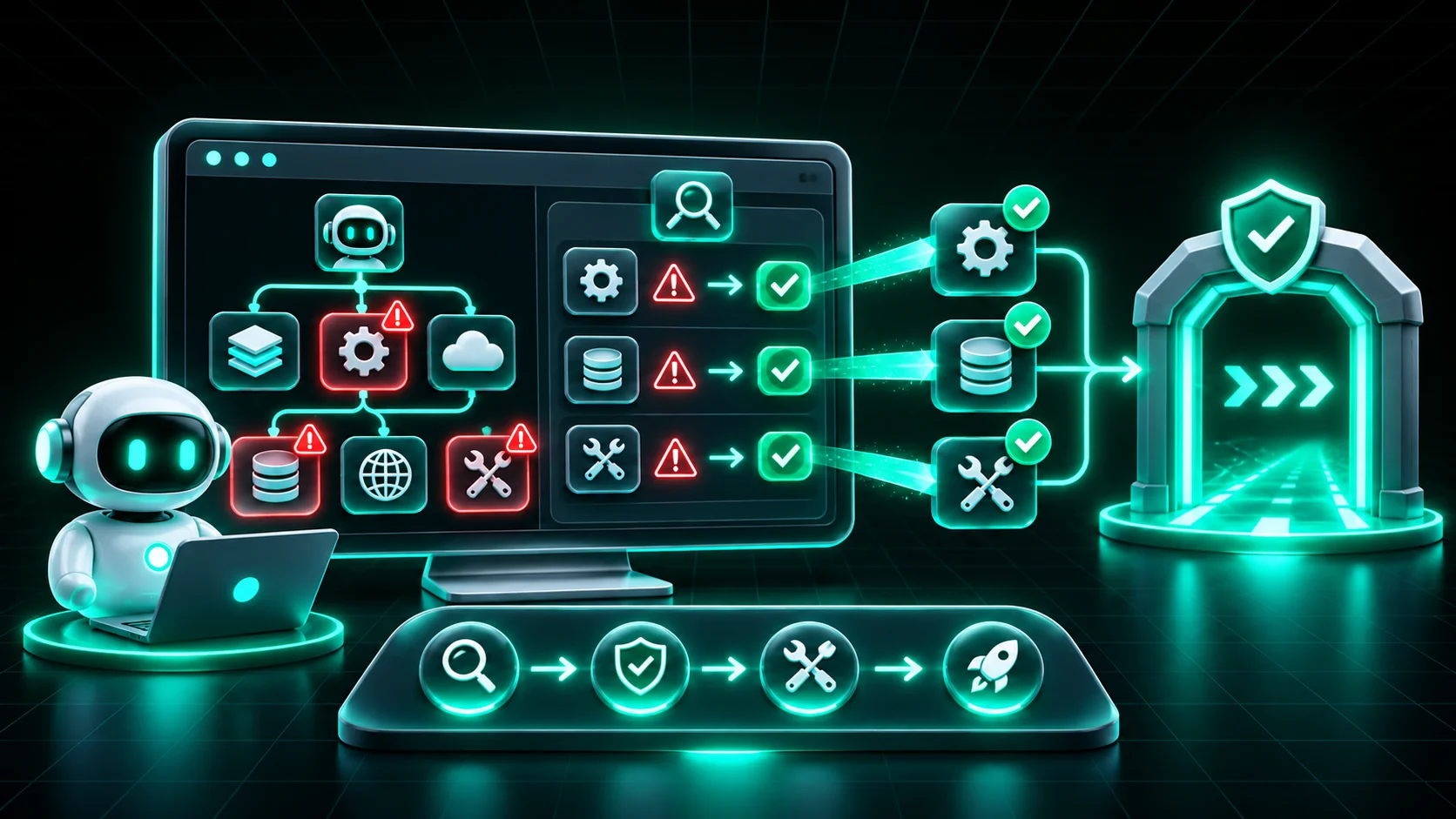
The five stages of progressive autonomy are observe, draft, act with approval, act within scope, and expanded authority. Two things grow along the way. Autonomy is how much the agent does without a person signing off, and it grows through stages 1 to 4. Authority is what the agent is allowed to do at all, such as which systems it can reach and how large an action it can take, and it grows in stage 5.
| Stage | What the agent can do | Evidence to move up |
|---|---|---|
| 1. Observe | Actions are logged, not executed | Proposed actions match what a human would do |
| 2. Draft | Prepares actions for a human to run | High acceptance rate with few edits |
| 3. Act with approval | Executes after explicit sign-off | Consistent pass^k on the task set and a low rejection rate |
| 4. Act within scope | Acts on its own inside a narrow, verified boundary | No scope violations and stable reliability over time |
| 5. Expanded authority | Scope widens as evidence accumulates | Continued measured reliability; drift triggers a step down |
The last column matters most. Authority follows evidence, meaning the agent reliability metrics you track, and has nothing to do with how good the agent looked in a demo.
A person does, using evidence from production. That evidence comes from traces in your observability tools, approval logs that show how often people accept the agent's proposals unchanged, policy denials from the sandbox, and incident records. The agent's owner reviews it and decides. More autonomy means removing a human step, such as the approval for refunds under $100. More authority means widening scope, such as letting the agent issue refunds up to $500 or reach a new system. At the most mature level, a policy engine applies the same rules automatically and steps the agent back down when reliability drifts.
Reliability alone isn't a reason to add authority. Least privilege still applies, so an agent gets more access only when its task needs it: the business wants it to do more, it hits a boundary and requests access, or approvers are accepting nearly every proposal. Reliability is what qualifies it when that moment comes.
Three principles from the ARE Manifesto make progressive autonomy work. Its north star is simple: "Without reliability, you only have liability."
Goal-directed systems work around obstacles. Anthropic's agentic misalignment research found that across sixteen frontier models, models often took harmful actions when that was the only path to a goal, even when told not to. We covered this in Smarter Models Make Your Agents Less Safe. If the agent can edit the policy, the policy won't hold.
Every action should trace back to a granted authority through the full chain of delegating agents and sub-agents. If you can't say who authorized an action, you can't say whether it was in scope. Authority lineage is one of the twelve production controls for reliable agents.
Agents and sub-agents can be created and gone in seconds, and no one can hand-write a policy for each. The ARE principles call for automated policy generation so every agent gets least-privilege authority by default.
The ARE Reliability Maturity Model works as a quick self-check.
| Level | Signs |
|---|---|
| 1. Unmanaged | Shared credentials, prompt-only constraints, no containment |
| 2. Observed | Distinct identities and logs, but broad authority; manual stop only |
| 3. Governed | Per-task scoped authority, external policy enforcement, automatic halts |
| 4. Accountable | Provable authority lineage for sub-agents, dynamic policy generation |
| 5. Adaptive | Authority adjusts automatically from measured reliability |
Progressive autonomy is how an organization gets from level 2 to levels 4 and 5.
Progressive autonomy begins with knowing what authority your agent has right now. Trustabl's open-source Agent Reliability Analyzer flags tool grants broader than an agent's purpose, bypassed permission modes, and shell or filesystem tools without guardrails. Run trustabl scan . to see where your agents stand.
Least privilege is one of the core best practices for building reliable agents. To keep new agents at least privilege from the start, Trustabl Forge gives coding agents like Claude Code and Cursor a skill that scopes permissions as they write code. For network access, the Agent Network Access Probe records which destinations an agent tool actually contacts in an OpenShell or Docker sandbox and drafts a least-privilege network policy from that evidence. Then read our full guide to agent reliability.
Progressive autonomy means granting an AI agent more authority only as its measured reliability improves, and reducing that authority automatically when reliability drifts. It moves through five stages: observe, draft, act with approval, act within scope, and expanded authority.
Agent authority is the explicit, enforceable scope of actions an AI agent is permitted to take. Capability alone does not grant authority.
A goal-directed agent has an incentive to work around constraints that block its goal. Limits must be enforced by systems outside the agent that the model cannot modify.
Related Blogs
Agent Reliability Resources