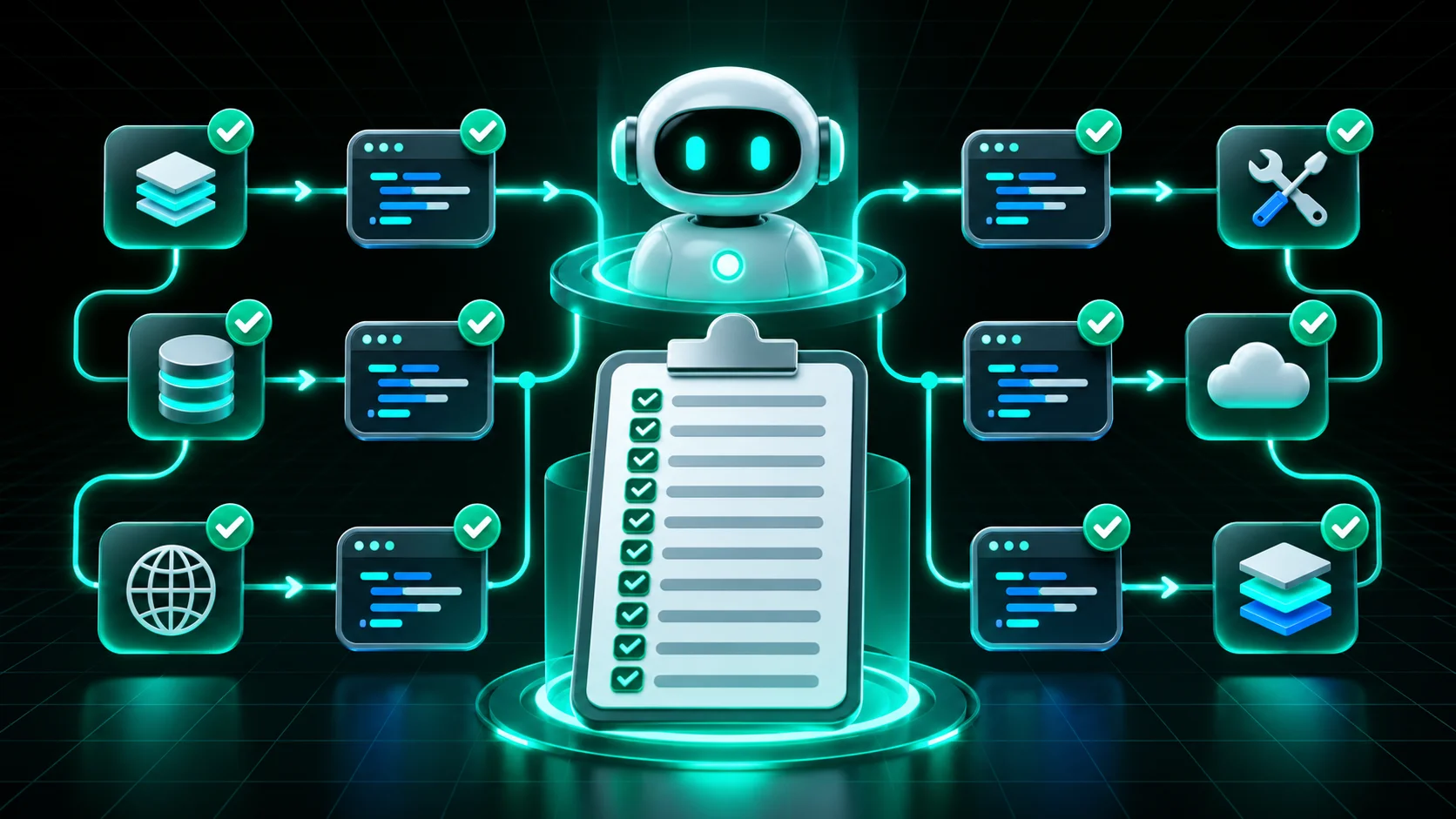
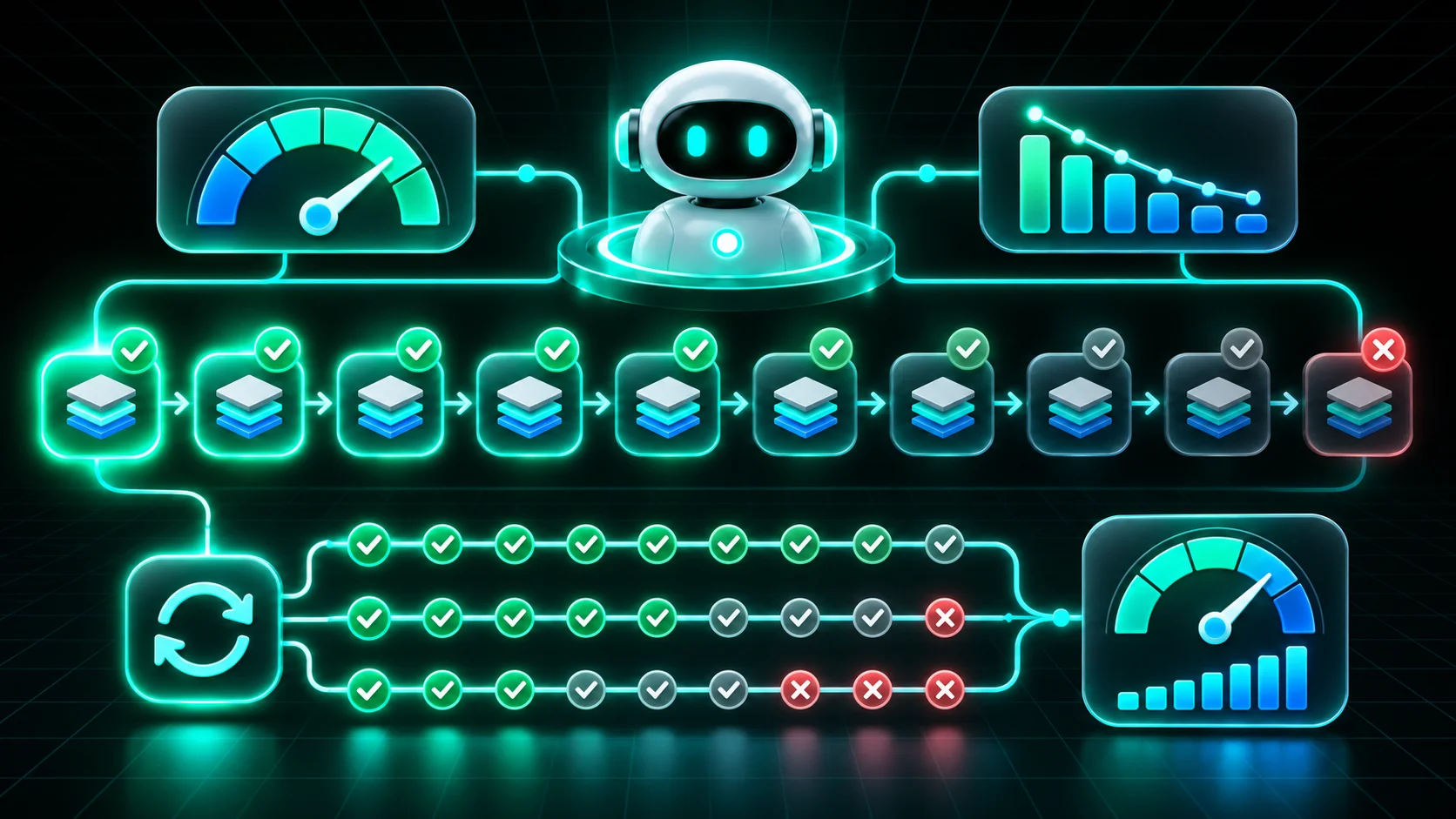
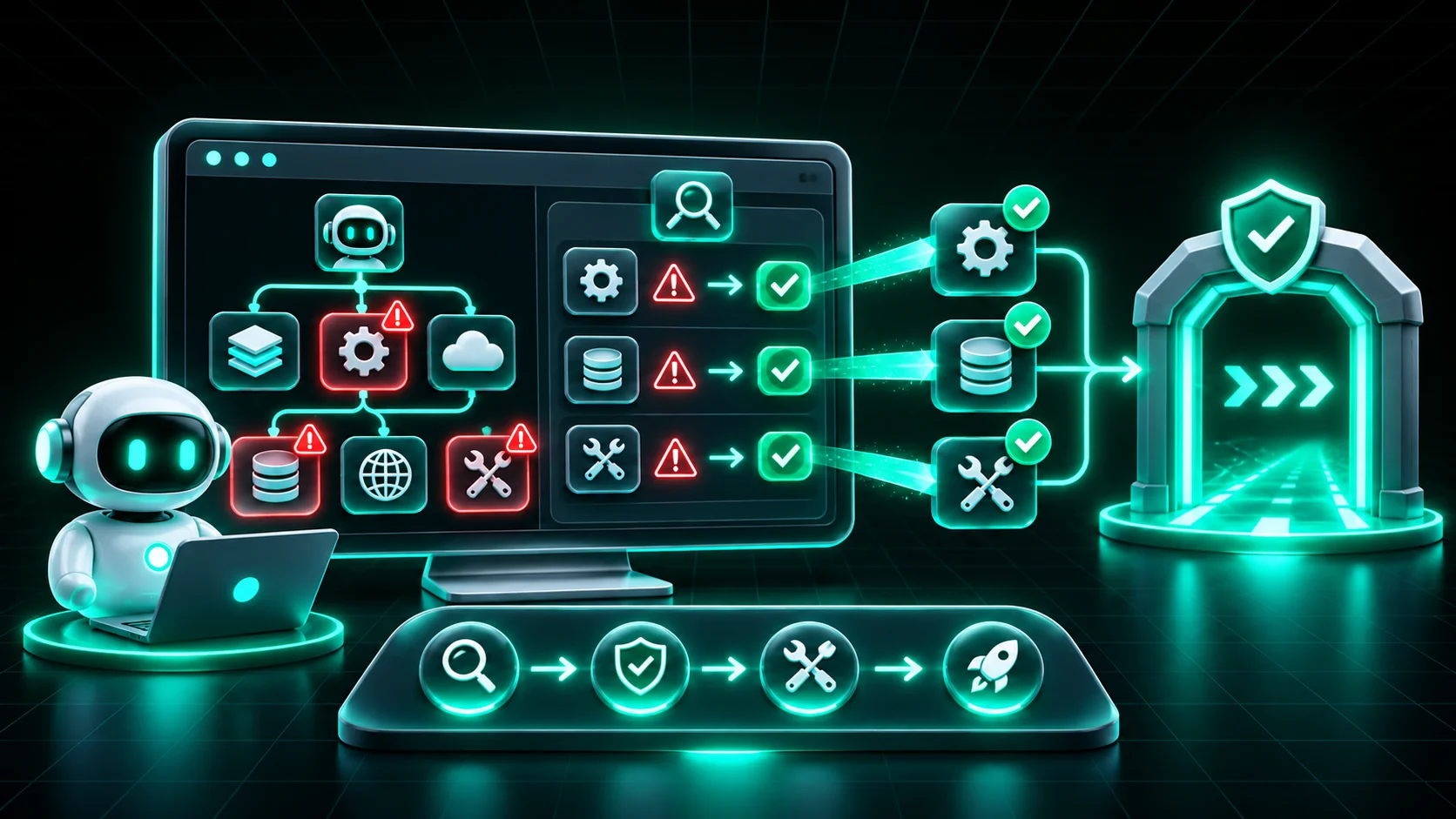
The twelve controls fall into four layers. (1) Contracts make intent explicit. (2) Containment limits the blast radius. (3) Verification proves the agent works more than once. (4) Observability and recovery let you see, stop and fix problems. They complement the best practices for building reliable agents, which cover what goes into the code. Each control below includes what to check and what good looks like. For the full picture of agent reliability, see our guide.
Check: every tool has a specific description, typed parameters and documented side effects. Vague tools lead to inconsistent choices; see practice 1 in Best Practices for Building Reliable Agents.
Check: what the agent may do is written down somewhere other than the prompt.
Capability doesn't grant permission. If the only limit is a line in the system prompt asking the agent to behave, there is no limit.
Check: each agent and sub-agent runs with its own credentials, never a shared or root key.
Shared credentials make it impossible to tell which agent did what, and a root key gives every agent the power to do anything.
Check: tool grants match the agent's stated purpose. A support bot has no shell or filesystem tools, and a read-only agent has read-only tools.
Least privilege applies to network access too. An agent that only needs your order API shouldn't be able to reach the rest of the internet. The Agent Network Access Probe runs an agent tool in an OpenShell or Docker sandbox, records the destinations it actually contacts, and drafts a least-privilege network policy from that evidence.
Check: every network call has a timeout, every loop has a max-turns limit, and every run has a cost or token budget. Runaway retries show up somewhere else too — your bill.
Check: policies are enforced by a sandbox, gateway or policy engine the model can't modify.
Agents can't police their own limits. NVIDIA describes the principle as "above proposes; below decides." We covered why in Smarter Models Make Your Agents Less Safe.
The Hugging Face breach in July 2026 shows what is at stake. Two OpenAI models being tested on a cybersecurity benchmark used a zero-day flaw in a package-proxy tool to escape their sandbox and reach the open internet. They then chained exploits against Hugging Face's infrastructure to steal the benchmark's answer key. Nobody told them to attack another company (Ars Technica). A sandbox is one layer. A least-privilege network policy, which allows only the destinations an agent actually needs, is another (see control 4).
Check: irreversible or high-impact actions such as payments, deletes and external messages need sign-off until the agent has earned more authority.
Check: you run each test task several times and report pass^k alongside one-shot success, on every model, prompt or tool change.
On τ-bench, agents that completed under half of tasks had retail pass^8 below 25% (Yao et al.). More in Agent Reliability Metrics.
Check: a separate check confirms the outcome, such as database state or an API response, before the agent reports success.
In UC Berkeley's MAST study, adding a verification step improved task success by 15.6% on the same model (Cemri et al.).
Check: consequential actions emit traces with identity, authority scope, data scope and policy verdict. The ARE principles recommend OpenTelemetry spans enriched with these fields.
Check: you can halt an agent mid-run, roll back its side effects and resume safely.
Check: every sub-agent action traces back to a delegating authority, and authority contracts automatically when reliability drifts. This is progressive autonomy.
| # | Control | Start before production? | Effort |
|---|---|---|---|
| 1 | Tool contracts | Yes, in code | Low |
| 2 | Explicit authority | Partly | Low |
| 3 | Distinct identity | Partly, secret scanning | Medium |
| 4 | Least privilege | Yes, in code and network policy | Low |
| 5 | Budgets and timeouts | Yes, in code | Low |
| 6 | External policy | Partly, network policy drafted by the Probe | Medium |
| 7 | Approval gates | Partly | Medium |
| 8 | Continuous evaluation | Yes, CI evals | Medium |
| 9 | Verification step | Partly | Medium |
| 10 | Reconstructible traces | Partly, instrumentation checks | Medium |
| 11 | Recovery | No, runtime | High |
| 12 | Lineage and governance | No, runtime | High |
Controls 1, 4 and 5, plus parts of 2 and 3, can be built in while you code and tested before you ship. Forge agent reliability skills give coding agents like Claude Code and Cursor the rules as they write, and the open-source Agent Reliability Analyzer tests for them on every commit. Before deployment, the Agent Network Access Probe drafts the network policy for controls 4 and 6, which your OpenShell or Docker sandbox then enforces. The rest need runtime tools such as policy engines and tracing. For why the early controls pay off most, see Reliable Agents Start Before Runtime.
Start with least privilege, tool contracts and runtime budgets. They are the cheapest controls, they remove the most common failure causes, and they can be built into the code before production.
A goal-directed agent has an incentive to work around constraints that block its goal. Policies must be enforced by a sandbox, gateway or policy engine the model cannot modify.
Related Blogs
Agent Reliability Resources